AAEL – Ambidextrous Agile Educational Leadership.
A framework for the joint design of (higher) education in the post-digital age
Localisation and classification
AAEL ist eine spezifische Auffassung und Praxis von Leadership im Bildungsbereich im Bezugsrahmen von Agilität und Ambidextrie, um unter dynamischen und mitunter krisenhaften Rahmenbedingungen agil und souverän handlungsfähig zu bleiben.
Das Rahmenwerk AAEL – Ambidextrous Agile Educational Leadership für die gemeinsame Gestaltung von (Hochschul-)Bildung in der Post-Digitalität (kurz: AAEL-Rahmen) – bisher benannt als Rahmenwerk Agile Educational Leadership bzw. AEL-Rahmen 1.0 – entsteht seit 2020 iterativ und inkrementell. Es wird bis auf Weiteres unter der bisher bekannten URL https://ambidextrous-agile-educational-leadership.de frei und offen publiziert. Das transdisziplinäre Rahmenwerk AAEL ist dynamisch zu verstehen und entwickelt sich mit zunehmender empirischer Fundierung kontinuierlich weiter zu einer nächsten, mit Blick auf die Passung zum Anwendungskontext (Hochschul-) Bildung, verbesserten Version.
Der AAEL-Rahmen schließt an vorangegangene Forschungsarbeiten, Entwicklungsprojekte und Transferaktivitäten von Prof. Dr. Kerstin Mayrberger an. Ihm zugrunde liegt demnach als Kontext im weiteren Sinne die Rolle und Gestaltung von Umgebungen und Rahmenbedingungen für ein partizipatives, offenes sowie vernetztes Lernen unter den Bedingungen der digitalen Transformation und in der Digitalität1. AAEL erweitert diese Perspektive durch Adaption der Konzepte von Agilität und Ambidextrie auf den Bildungsbereich. Und bezieht sich explizit auf die Gestaltung von (Hochschul-)Bildung als Umgebung für Lernen und Bildung in der (Post-)Digitalität im weiteren Sinne als Ganzes, d.h. über alle Ebenen hinweg als Zusammenspiel von Mikro‑, Meso- und Makroebene.
Zur besseren Verständlichkeit und Nachvollziehbarkeit wird das AAEL-Rahmenwerk an dieser Stelle als integriertes Ganzes seiner wesentlichen Teile beschrieben und visualisiert. Dieses Kapitel gibt also einen funktionalen Überblick in Form einer eigenständig lesbaren Kurzversion, die die wesentlichen theoretischen wie handlungsorientierten Elemente des AAEL-Rahmens in komprimierter Form beschreibt und argumentiert. Auf diese Weise soll hier sowohl ein erster wie auch erleichterter Zugang zum AAEL-Rahmenwerk ermöglicht werden.
Der Fokus der Kurzversion liegt also auf einer prägnanten Darstellung der zentralen Inhalte. Wer tiefer einsteigen möchte, findet inhaltliche Einordnungen, Auswahlbegründungen und berücksichtigte Quellen in den weiterführenden Kapiteln dieses AAEL-Online-Buches. Auch diese werden weiterhin fortlaufend ergänzt und aktualisiert.
Das Rahmenwerk AAEL lässt sich im Wesentlichen entlang spezifischer Elemente kompakt darstellen, die in den Vertiefungskapiteln ausführlicher beschrieben zu finden sind. Diese liefern zugleich auch Gründe dafür, wieso es unter den derzeitigen Bedingungen sinnvoll erscheint, ein Rahmenwerk wie AAEL als lösungsorientierten Weg zur gemeinsamen Gestaltung von Veränderungen für eine zukunftsfähigen (Hochschul-)Bildung in der Post-Digitalität anzubieten.
Die Motivation für die Entwicklung dieses Rahmenwerks über die letzten Jahre speist sich vor allem aus dem beobachteten Umgang mit den krisenhaften Situationen in dieser Zeit, der Herausforderung die die digitale Transformation seit Jahrzehnten darstellt sowie die Perspektive nach vorne auf Komplexität und Wandel als alltägliche Kontextbedingungen für diejenigen, die Bildung gestalten und den Bildungsauftrag für die nächste Gesellschaft erfüllen sollen. So zielt Ambidextrous Agile Educational Leadership für die gemeinsame Gestaltung von (Hochschul-)Bildung in der Post-Digitalität (AAEL) darauf ab, konzeptionell werte- und handlungsorientierte Prinzipien zu beschreiben und miteinander in Verbindung zu bringen, die einen stimmigen Weg anbieten, um die Rahmenbedingungen für Bildung im alltäglichen Wandel gemeinsam besser zu gestalten und darin miteinander agieren zu können. Damit ist der Anspruch verbunden, personale wie organisationale und gar politische Akteur_innen in die Lage zu versetzen, Bedingungen zu schaffen, um gegenwärtige Bildung mit Blick auf potenziell kommende An- und Herausforderungen trotzdem stetig verbessern und souverän mitentwickeln zu können. Dabei wird neben anderen gesellschaftlichen Transformationsprozessen insbesondere die digitale Transformation als Kontextbedingung betrachtet und herausgestellt, die veränderte Rahmenbedingungen, Interaktions- und Lernformate und Perspektiven auf Bildung in der Post-Digitalität mit sich bringt.
Dabei ist zu betonen, dass sich die Umsetzung und Ermöglichung eines AAEL gleichermaßen an Personen wie Organisationen in der (Hochschul-)Bildung richtet und konsequenterweise auch Politik und gesellschaftliche Bedingungen für Bildung mitberücksichtigt. Entsprechend adressieren die Merkmale von AAEL immer alle Akteur_innen sowie Ebenen, also Mikro‑, Meso- und Makroebene, im System von (Hochschul-)Bildung.
AAEL visualization
The following visualisation provides an abstract representation of the elements of the current version AAEL 2.1 and contextualises their meaning in the context of AAEL here in the necessary brevity.
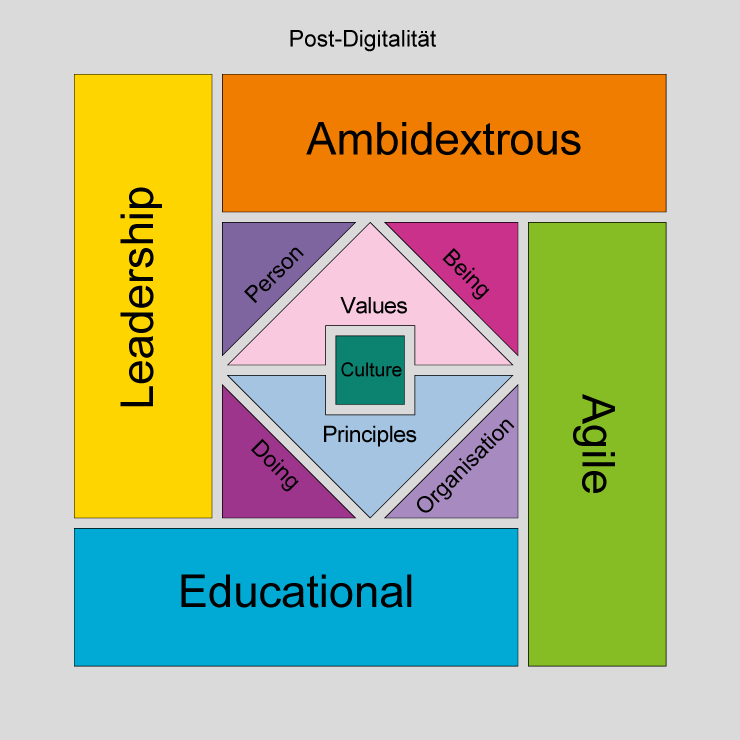
Figure: Visualisation of the AAEL framework – Ambidextrous Agile Educational Leadership for the joint design of (higher) education in the post-digital era, version 2.1.1.
The visualisation was developed on the basis of a construction kit. Within the given framework (of post-digitality), there are individual coloured building blocks that together fill the space within the framework. Blocks with corners and edges in different shapes were chosen that can be combined in more than one way to form a whole and can thus be connected to each other in any case. One can imagine three-dimensional, movable elements here.
The selected colours and shapes indicate direct connections or unique positions. They are taken up again for better orientation for the transfer of practice to (higher) education with its methods and practices. In the visualisation, the respective building blocks represent the thematic elements that together model and fill the AAEL framework.
In the following, these building blocks are briefly described and categorised individually, and a reference is given for further exploration of the respective chapter. In the present variant of a deductive presentation, this is done from the general to the specific. This means from post-digitality as a context to the central eponymous concepts and an emergent AAEL culture at the centre.
Post-Digitality
Post-Digitalität ist in dieser Visualisierung als derzeit primäre Herausforderung und wichtiges Bezugsfeld für Bildung die Grundfläche der gesamten Grafik. Sie liegt wie eine Folie hinter den übrigen Bausteinen und kann bildlich auch als Kasten des Baukastens verstanden werden. Hier ist das Rahmenwerk entsprechend der Titelgebung sinnbildlich in der Digitalität eingebettet und kontextualisiert. Post-Digitalität steht für das Digitale und den derzeitigen kulturellen Zustand des digitalen Wandels als die vielfach thematisierte Kontextbedingung für (Hochschul-)Bildung in der eher technologisch zu verstehenden digitalen Transformation. Weil Post-Digitalität derzeit wiederholt als zentrale Kontextbedingung und gesellschaftlichen Herausforderung für (Hochschul-)Bildung thematisiert wird und sie zugleich tiefgreifend gesellschaftlichen Wandel prägt, bildet sie derzeit die zentrale Kontextbedingung für den AAEL-Rahmen2
Ambidextrous, Agile, Educational, Leadership
Die namensgebenden konzeptionellen Elemente des Rahmens AAEL sind Ambidextrous, Agile, Educational und Leadership.Es wird hier die englische Bezeichnung bevorzugt, weil sie neben internationaler Anschlussfähigkeit an bestehende Diskussionen auch die Verwendung von Begriffen im weiteren Verständnis ermöglicht. Diese vier konzeptionellen Elemente sind durch vier verschieden farbige Rechtecke visualisiert, die selbst wiederum als Einfassung für die nächsten inneren Bestandteile des hier als Baukasten visualisierten Rahmenwerks gesehen werden können.
Der Baustein Ambidextrous ((siehe ausführlicher zu Formen von personaler und organisationaler Ambidextrie im entsprechenden Vertiefungskapitel hier im AAEL-Buch 1.0)) steht für eine zielgerichtete Erkundung von dem nächsten sinnvollem Schritt in Form von gleichzeitiger Optimierung von Bewährtem und Erprobung, Entwicklung und Entdeckung von Neuem in Form einer integrierenden und ausbalancierenden Perspektive auf Wandel. Der nächste Baustein Agile ((siehe ausführlicher zu Agilität und Agilität im Bildungsbereich im entsprechenden Vertiefungskapitel hier im AAEL-Buch 1.0)) weist auf den Prozess der schrittweisen, lernenden Anpassungsbereitschaft an komplexe, dynamische Kontexte hin, wie es auf (Hochschul-)Bildung zutrifft. Ambidextrie und Agilität lassen sich in dieser Logik durchaus auf vielfältige Bereiche anwenden. In diesem Beitrag steht mit dem Baustein Educational ((siehe ausführlicher zum Fokus auf Bildung und ihre Relevanz zukunftsorientierte Handlungsfähigkeit im Wandel im entsprechenden Vertiefungskapitel hier im AAEL-Buch 1.0)) allein der (Hochschul-) Bildungsbereich mit seinen Besonderheiten im Fokus. Er wird daher mit Educational umschrieben, um über Lehre und Lernen hinaus zu verdeutlichen, dass Bildung im weiteren Sinne, mindestens im strukturellen, personalen, kulturellen und politischen Kontext betrachtet gehört, um nachhaltig zu gelingen. Der vierte rechteckige Baustein Leadership ((siehe ausführlicher zum Verhältnis von Management und Leadership sowie Formen von Leadership im entsprechenden Vertiefungskapitel hier im AAEL-Buch 1.0)), das auf die Ermöglichung (Eigen-)Verantwortung und Leadership zu übernehmen bzw. übernehmen zu können abzielt, adressiert in einem die Ebenen übergreifendem Verständnis von Professionalität, das Subjekt oder die Personen in ihren jeweiligen Handlungsbereichen und Rollen innerhalb organisatorischer Strukturen und institutioneller Bedingungen von Bildung. Diese vier Elemente lassen sich transdisziplinär verbinden.
Umrundet von diesen vier Bausteinen Ambidextrous, Agile, Educational und Leadership, finden sich weitere Elemente. Diese adressieren den Entwicklungs- und Handlungsraum der Akteur_innen einschließlich Prinzipien und Werten, wie auch die Emergenz einer spezifischen Kultur im Rahmen von AAEL. Im Einzelnen sind das die folgenden Elemente in Form von Bausteinen bzw. die Baustein-Gruppe:
People, Being, Organisation, Doing
Das Zusammenspiel von Personen mit ihrer Persönlichkeit und Haltungen sowie Organisationen mit ihren Regeln und Strukturen einerseits und einem AAEL Doing und Being andererseits, wird in diesem Baukasten als vier gleichwertige und gleichfarbige Dreiecke dargestellt. Sie bilden zusammen selbst ein inneres Quadrat und formen so die Mitte des Baukastens innerhalb der konzeptionellen Elemente AAEL. Die vier Elemente Personen, Being, Organisation und Doing werden im Rahmen von AAEL als die wesentlichen Entwicklungs- und Handlungsräume der Akteur_innen begriffen3.
Doing und Being wie auch ihr Zusammenspiel mit Personen und Organisation sind nur begrenzt festschreibbar, weil sie sich im Handeln über Methoden und Praktiken (neu) ausbilden und im Zuge von persönlichen Reflexions- und erfahrungsbasierten Wachstumsprozessen (weiter) entwickeln. Sie stehen in diesem Rahmen gemeinsam für eine spezifische Praxis im Handeln und Sein einer Person in und mit der Bildungsorganisation entlang geteilter Ziele oder auch einer Vision, jeweils mit ihrer Geschichte und Zukünften.
Values, principles
At the centre of the visualisation are specific AAEL values and principles in the form of two triangles of the same colour that complement each other to form a rhombus. Both values and principles arise from the post-digital context and the conceptual elements of AAEL. Both are united by the fact that they are developed by the persons in interaction with their organisation and its educational mission. They are to be codified and, where necessary, specifically negotiated in order to be shared. Instead of a static set of rules, they form situational and context-dependent guidelines for all actors in the interplay between Being AAEL and Doing AAEL in their everyday actions in the complexity of education. They are therefore placed as a core within the rhombus and there in turn form the framework for the last, central building block (see below for more details in this summary).
Culture
In the visualisation, culture is located in the centre of the building block with a square. In the interplay of the previously mentioned building blocks, a suitable culture can emerge and develop over time within the framework of AAEL (in short, AAEL culture), which is seen here as a common, negotiable, sustainable and dynamic basis for a long-term cultural change in (higher) education and is named as such.
AAEL game rules
For the AAEL framework, the image of a modular system is used, and the following explanations can accordingly be read as a kind of set of rules.4 These rules aim to enable a potentially successful interplay of the individual components, their handling, and their relationships with one another.
Every brick counts!
One of these rules is that, despite flexibility and adaptability, each building block serves a specific purpose and has its value in the structure of the AAEL construct, so that AAEL can develop consistently as a whole.
The most important rule of the game is therefore not to completely ignore any of the building blocks and to consciously deal with all perspectives – each with a different weighting – in a systemic way. In the sense of a construction kit and similar to a tangram game (see https://de.wikipedia.org/wiki/Tangram), the aim is to symbolically and concretely interweave all the parts with each other and consider them together for each ‘figure’ or each new iteration.
Partial acceptance of the AAEL core or completely omitting building blocks (‘cherry-picking’) could lead to not addressing and dealing with all the questions and issues addressed in AAEL. In case of doubt, intentional omission is more likely to contribute to the failure of AAEL.
Winning together!
The AAEL framework is not a recipe or a step-by-step guide that is equally the one way or the one suitable solution for all and can be worked through according to plan. Rather, the AAEL framework offers building blocks that, when used in a joint, dynamic interaction between actors in the respective educational organisation with a view to the next, future development steps, result in a suitable, coherent whole. The AAEL framework always starts from what is already there in the organisation and in the people. What is important for AAEL is a shared personal and organisational willingness to engage in change in the form of an ongoing learning process or learning journey. To stay with the image of the construction kit, a journey during which everyone has and is given the opportunity through testing and feedback to repeatedly touch the building blocks and to be able to rebuild and rebuild them.
What does not fit is not made to fit!
If it is clearly not possible to reach a common understanding about the interaction of the AAEL building blocks, it is better to choose and pursue a different starting point as a path for further development. In this respect, a reasoned or intentional omission or avoidance of building blocks in AAEL can be a first developmental step towards finding a way for the respective educational organisation to deal with change and transformation. If this is the case, AAEL is not suitable.
AAEL values
AAEL is to be understood as a primarily value- and principle-based framework for making decisions and taking action in complex situations, such as those that arise in the (higher) education sector on a daily basis. This framework is designed to help individuals and groups make independent, value-oriented decisions and take action in order to counteract arbitrariness. This basic idea of a framework for action, which is spanned across specific values and principles, was adapted from the context of the Agile Manifesto for the field of (higher) education with the AAEL framework.
Stating values in the AAEL framework is double-edged. Because only as shared values accepted by all actors as a basis for the joint action process do they make sense and build trust and at the same time cannot simply be prescribed. So the task remains to understand values from the outset as the result of constant communication and appreciative negotiation. With agility in mind, it can be concluded that consensus as a democratic form of co-determination regarding the common value base can already enable sustainable and meaningful cooperation. AAEL values are therefore always subject to renegotiation in their respective forms in the respective educational areas in order to create a common basis. The AAEL framework thus stands for a fundamental democratic conviction. It is about mutual facilitation of actual participation, willingness to self-organise and to take responsibility in a trusting environment, while all participants are aware that power is traditionally distributed differently in (higher) education. (For more on the differentiation between forms of participatory design of environments for collaborative learning, see previous work at: https://partizipative-mediendidaktik.de.)
For this reason, trust and responsibility are regarded and emphasized as central values in the AAEL framework.
Trust
… because trust is the basis for successful cooperation and mutual support and strengthens relationships and (psychological) security. Trust in each other and among each other – as well as in formal, structural, legal and social conditions – is a condition and consequence of all other values. Because trust cannot be prescribed, it is acquired in responsible cooperation with each other, it is strengthened and it can be lost in the same way.
Responsibility
…because taking on and delegating responsibility is fundamental to participatory (learning) processes at all levels, to collaborative work contexts and to functioning self-organisation in groups, teams and organisations. Responsibility also means long-term commitment to sustainable educational processes and the willingness to critically reflect on the effects of one’s own actions in education in the post-digital age.
The following are equally relevant values as the basis for an AAEL and its principles as future-oriented leadership in the education sector within the reference framework of agility and ambidexterity:
Courage
…because AAEL invites you to be courageous and to take risks in view of an uncertain future, to proactively approach change as a long-term process despite uncertainties. Courage also includes the willingness to see rapid testing and mistakes as learning opportunities and to create an environment in which innovative ideas can be tested and risks taken. AAEL supports the willingness to innovate and to manage uncertainty in complex situations.
Openness
…because AAEL thrives on personal openness and open structures and a willingness to be transparent and to freely exchange materials, information and ideas in the broader sense of an Open Educational Practice (OEP). Openness also means continuously integrating new insights and technological developments and constantly developing both personally and in (higher) education, thus being able to react flexibly to new challenges and opportunities.
Respect
…because an AAEL is about having respect for people and recognising and appreciating the contributions and perspectives of everyone involved in the collaboration – and giving feedback with respect for the person. Respect in this sense means interacting with all actors and perspectives on an equal footing and ensuring that all voices are heard and valued.
Diversity
…because AAEL consciously seeks the possibilities beyond dualities in the in-between and outside, and the framework, with a view to diversity in education in post-digitality, integrates correspondingly discursive and inclusive perspectives and backgrounds in order to design a suitable sustainable education for all. Diversity is thus a continuous framing process that must be actively cultivated and promoted to create an inclusive environment.
Feedback
…because constructive feedback motivates rapid learning in terms of outcome with a view to achieving the goal and promotes personal growth within the organisation. Feedback is important in both a formative and a summative sense to promote continuous learning and the achievement of goals.
Engagement
…because the AAEL framework relies above all on the willingness and (self-)commitment to achieve common goals in order to continuously improve education through rapid feedback. Engagement requires a balance between individual responsibility and collective commitment to the iterative achievement of common goals. Goals such as process design require a reliable commitment.
Focus
…because in the complexity of education, focus and concentration on the next task at hand is important. In this respect, focus means setting clear goals and intermediate goals and pursuing them consistently, while remaining motivated, efficient and effective as you take the next steps towards your goal.
Communication
…because communication, especially in the post-digital age, is essential for the coordination and constant exchange between individuals, within teams and organisations, in order to continuously improve education together. This applies to all forms of communication, whether verbal, non-verbal or digital.
AAEL Principles
The AAEL framework is not a detailed set of rules and it is not a step-by-step or phased guide. Rather, it establishes central principles along the conceptual elements. The AAEL values and principles are intended to create a basis for a cooperative, innovative and sustainable design of (higher) education. They are aimed at the feasibility of implementing AAEL in practice and are to be understood as guiding our joint behaviour as a way forward and as a roadmap for action5.
The following AAEL principles are essential, value-based guidelines that structure actions and decisions, promote flexibility and adaptability in different situations, and can be applied across and between disciplines. In the context of agility and ambidexterity, these principles provide orientation and a basis for coordinated and coherent personal and collective action in a variety of situations, for example in teams, in departments and across all levels, in the sense of future-oriented leadership in education.
The following principles for action can be summarised for version 2.1 of the AAEL framework:
Value-based action for sustainable higher education
The principle of value-based action within the framework of AAEL aims to facilitate a culture in higher education that is based on shared values and principles. This creates a trusting, respectful and innovative environment that promotes participatory learning and self-organisation. By emphasising responsibility, trust, courage, openness, respect, diversity, feedback, commitment, focus and communication, a sustainable and future-oriented education is jointly created and shaped.
Post-digitality as a matter of course
The guiding principle of self-evident post-digitality aims to design higher education in such a way that it takes place confidently in both the analogue and the digital. The AAEL framework assumes ubiquitous mediality and a profoundly mediatised society. In this society, digitality is integrated as a cultural condition for action for interaction and communication in the digital transformation. The post-digital perspective on education recognises the everyday permeation of digitality and strives to create a flexible, resilient and sustainable educational landscape that meets the challenges and needs of a democratic society.
Bridging the duality of exploration and exploitation
The principle of bridging duality aims to strengthen a culture in educational organisations and in the education sector in general, including higher education, that values and promotes both risk-taking and creativity as well as efficiency and optimised routines. Such a culture makes it possible to navigate flexibly and confidently between new approaches and existing processes and to adapt to changing conditions. This culture supports individual initiative and self-organisation as well as systematic efficiency and optimised routines in order to sustainably promote both personal and institutional development. By integrating organisational and individual ambidexterity, it is possible to proactively shape (higher) education and strengthen the situational adaptability, developmental capacity and innovative ability of educational institutions and education in the broader sense in a fast-paced, complex and uncertain world.
Sovereign agility in the education sector
The principle of sovereign agility aims to design (higher) education in such a way that (higher) education organisations can confidently meet development requirements and changes from both inside and outside, thus managing complexity in an agile manner and with appropriate quality. This applies both to the mode of exploitation (optimisation and efficiency of existing processes) and to that of exploration (new and innovative). An agile educational organisation is characterised by flexibility, adaptability and a continuous willingness to learn and improve. Agility makes it possible to react quickly and effectively to new challenges while maintaining stable and efficient processes. Agile collaboration in the individual educational organisation relies on agile values, as integrated in the AAEL values.
Social responsibility and educational mission
The principle of social responsibility and the educational mandate aims to shape the framework conditions for (higher) education in such a way that they promote both personal development and the assumption of social responsibility, while also enabling fundamental educational tasks to be fulfilled. Education contributes to the development of a critical, value-based and democratic society. A strategically meaningful orientation through a shared vision for networked (higher) education strengthens the understanding of the educational mission, which shapes values and principles for joint action.
Integrated leadership in education
The principle of integrated leadership means developing leadership in higher education as a variant of transformational leadership. With a view to participation and self-organisation, this includes integrating both the flexibility and adaptability of agile leadership and the simultaneous optimisation and innovation of ambidextrous leadership. This requires an overarching leadership culture that promotes the personal responsibility and self-organisation of all actors equally and enables a bridge to be built between leadership in traditional and modern organisational structures. Individuals who want to and are able to take on leadership in the sense of the AAEL framework act, among other things, with a coaching attitude to support, inspire and encourage individuals, groups or teams to take on responsibility. A participatory leadership culture of this kind can contribute to continuous development and community engagement, and comprehensively strengthen higher education, both in terms of meeting the complex and dynamic demands of modern society and in terms of jointly shaping further development.
Conclusion
AAEL is a specific conception and practice of leadership in the field of education in the context of agility and ambidexterity, in order to remain agile and confident in the face of dynamic and sometimes crisis-ridden conditions.
The long-term goal is to arrive at a sovereign, joint implementation of goals for education in all its complexity in the post-digital age through the consistent practice of AAEL, joint implementation of goals for education in its complexity in the post-digital age, so that a specific AAEL culture can emerge and grow in relative calm and relaxation along the way – and over time, in the constant interplay between AAEL-Doing and AAEL-Being, it can be differentiated in the joint action and design of higher education (see the detailed chapter AAEL Practice). This means that a foreseeable next crisis or complex challenge can be mastered as confidently as possible by everyone on the basis of these individual and shared resources. The AAEL framework thus offers actors in education an opportunity to open up a comprehensive learning space of participation and self-organisation for individuals and organisations alike. It contributes to the agile joint design of education in order to be able to act responsibly, purposefully and continuously in the in-between, both individually and together, along shared values and principles, in order to be able to act proactively and confidently in the in-between, both individually and together, along a shared vision and a meaningful goal, in order to be able to act responsibly, purposefully and continuously in the in-between, under uncertain contextual conditions in the post-digital age.
The conceptual AAEL framework is both part of and a reference point for its transfer for application and integration into (higher) education practice, which is constantly being produced, co-developed and further developed by all actors in their respective fields of action at the micro, meso and macro levels, in order to improve (higher) education together ( see the following independent chapter on the transfer of the AAEL framework to educational practice using the example of higher education (in preparation) )).
Letzte Aktualisierung am 14.03.2025 (Changelog)
- Digitalität wird hier im Verhältnis zur Digitalisierung im Sinne Felix Stalders verstanden; vgl. dazu u.a. folgenden Beitrag, sowie ausführlicher zur Post-Digitalität im Vertiefungskapitel Digitaliät (hier die aktuell gültive Version 1.0) im AAEL-Buch [↩]
- siehe ausführlicher zu Digitalität, Digitalisierung und Post-Digitalität im entsprechenden Vertiefungskapitel hier im AAEL-Buch 1.0 [↩]
- siehe ausführlicher zur Personenorientierung und Partizipation im Rahmen von AAEL im entsprechenden Vertiefungskapitel hier im AAEL-Buch 1.0; ein gesondertes Kapitel zum Fokus Organisation ist in Vorbereitung [↩]
- In line with the creation approach of the Scrum Guide, the AAEL framework not only follows a version-based evolution but also adopts the idea of a ‘set of rules’ (‘Rules of the Game’) to establish boundaries for arbitrary modifications. [↩]
- central principles for the AAEL framework are described based on the creation of the Agile Manifesto. [↩]

